


How To Procure Precision Alloys For Aviation Navigation, Guidance And Control Systems?
Jan 16, 2026
Leave a message
Core logic: Why must it be a precision alloy?
Aerospace vehicle design adheres to four fundamental principles: lightweight, high reliability, long lifespan, and resistance to extreme environments. Ordinary materials cannot simultaneously meet these requirements. Therefore, engineers have turned to precision alloys "designed for function."
Navigation and guidance systems are the "brain" and "cerebellum" of an aircraft. They must:
- Absolutely Precise Sensing: The physical properties of measuring elements must remain extremely stable, and the output signal must not drift, regardless of drastic changes in external temperature (from -55°C at high altitudes to +85°C under direct sunlight).
- Absolutely Sensitive Response: They must have extremely high responsiveness to weak signals (such as changes in the Earth's magnetic field or minute accelerations).
- Absolutely Reliable Over the Long Term: Their performance must not degrade under vibration and shock conditions lasting tens of thousands of hours.
- Absolutely Quiet: They must not generate stray magnetic fields that interfere with other precision electronic components.
Ordinary materials are completely unsuitable due to thermal expansion and contraction, unstable magnetic properties, and elasticity variations. Precision alloys are the only solution.
Four Key Alloy Categories and Procurement Core
(Your Operation Manual)
The following four types of alloys form the cornerstone of this system's hardware. When procuring them, their unique performance characteristics must be considered.
1. Constant-elasticity alloy - The "heart" material of inertial devices
- Representative grades: Ni-Span C (UNS K94610), Elinvar, domestic 3J58.
- Key applications: Gyroscope resonant beams, accelerometer flexible pendulums, precision springs.
- Core physical properties: Temperature coefficient of elastic modulus approaches zero.
Lork Group constant elasticity alloys
learn more
 Ni-Span C
 AMS 5876 / UNS R30003 / Elgiloy Material
 Ni-Span-C Alloy 902 Nickel Strip
Required clauses in the procurement technical agreement:
"The rate of change of the elastic modulus (E) of the material in the temperature range of -55°C to +85°C, i.e., the temperature coefficient of elastic modulus βE ≤ |±5| × 10⁻⁶/°C." (The smaller the value, the higher the grade and the more expensive the price.)
Required document: βE full-temperature range test curve report (issued by the supplier or an authoritative third party).
2. Soft Magnetic Alloys - The "Soul" Material of Magnetic Sensors
- Representative Grades:
High Permeability Type: 1J79 (Permalloy), 1J85 (Super Permalloy) - Used in fluxgate sensors and high-sensitivity magnetic shielding.
High Saturation Magnetism Type: 1J22 (High-Saturation Iron-Cobalt-Vanadium) - Used in torque converters and small motor poles to provide a strong magnetic field.
- Core Physical Properties: Extremely high permeability (μ) and extremely low coercivity (Hc).
Lork Group Soft magnetic alloys
learn more
 Moly Permalloy Strip
 Permalloy 80 Pipe
 Vacoflux 50 / Co50 / Hiperco 50 / 1J22 Soft Magnetic Alloy
Required Terms in the Procurement Technical Agreement:
"Under a weak DC field (H=0.4 A/m), the initial permeability μi ≥ 80,000; coercivity Hc ≤ 1.2 A/m." (Taking Permalloy - 1J79 as an example)
Required Documents: Complete test reports of DC magnetization curves (B-H) and permeability curves (μ-H).
3. Low Expansion/Sealing Alloys - The "Skeleton" Material of Vacuum Devices
- Representative Grades: Invar (UNS K93600), Alloy 52 (UNS K94600), Alloy 42 (UNS K94100).
- Key Applications: Hermetically sealed with glass and ceramics; used in the manufacture of gyroscope housings, resonant cavities, and laser bases. Ensures synchronized expansion and contraction of the metal and insulating materials during temperature changes, preventing stress-induced cracking or leakage.
- Core Physical Properties: Coefficient of thermal expansion (CTE) highly compatible with matching materials (such as alumina ceramics).


The procurement technical agreement must include the following clause:
"The average coefficient of thermal expansion of the material, within the temperature range of 25°C to 450°C, must match that of 'XX grade alumina ceramic,' with CTE = (target value ± 0.5) × 10⁻⁶/°C."
Required document: CTE test report, specifying the matching ceramic grade.
4. High-Elasticity, High-Fatigue-Strength Alloys - The "Tendon" Material for Actuators
- Representative Grades: Precipitation-hardening stainless steels (e.g., 17-4 PH, 15-5 PH, Custom 450), high-strength cobalt-based/nickel-based alloys (e.g., MP35N).
- Key Applications: Precision springs, diaphragms, and small actuator shafts in servo valves. Requirements include resistance to fatigue and deformation under high-frequency, short-stroke cyclic loading for millions of cycles.
- Core Mechanical Properties: High yield strength, ultra-high fatigue limit.
Lork Group High elasticity, high fatigue strength alloys
learn more
 AMS 5604 17-4 PH Sheet
 AMS 5617 / Stainless Steel Grade Custom 455 Round Bar
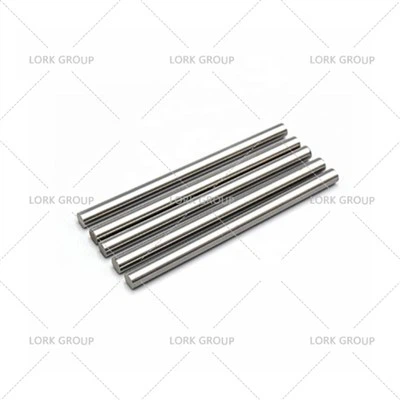 AMS 5844 MP35N
Required Clauses in the Procurement Technical Agreement:
"The material, under H900 aging condition, has a yield strength Rp0.2 ≥ 1200 MPa; and fatigue strength (S-N curve) data at 10⁷ cycles must be provided."
Required Documents: Mechanical property report and fatigue test data (if available).
Ironclad Rules for Supplier Selection and Quality Control
(Your firewall & We arsenal)
1. For procuring these types of materials, supplier qualifications are 100 times more important than price.
Supplier Thresholds (All are Essential):
- AS9100 Certification: The aerospace quality system, the entry ticket. (Lork Group has obtained this certification.)
- OEM Approved Supplier: Must be a company listed in the qualified supplier lists of AVIC, COMAC, or major international aerospace manufacturers.
- NADCAP Certification: For alloys involving special processes (such as vacuum heat treatment, protective atmosphere heat treatment), suppliers should hold NADCAP certification. This is the "gold standard" of the international aerospace industry.
- Pure Melting Capability: Must employ vacuum induction melting (VIM) or more advanced processes to ensure extremely low impurity (oxygen, sulfur, phosphorus) content in the material. Impurities are killers of performance stability.
Lork Group is still actively exploring the necessary certifications and qualifications for supplying aerospace materials.Since very few suppliers meet all of the above criteria, Lork Group hopes to continue to deepen its cooperation with global customers in the aerospace industry and learn to develop more relevant qualifications.
2. Quality Testing and Verification Process (Non-Compromising):
- First Article Inspection: For initial cooperation, a small batch purchase is required, and the material must be submitted to a nationally recognized or aerospace industry-recognized authoritative testing institution (such as: Beijing Institute of Aeronautical Materials, Materials Testing Center of the XX Research Institute of China Ordnance Industry Group) for full-performance, destructive testing. The testing program must cover the aforementioned core physical properties.
- Batch Validation: Each batch of materials must be accompanied by a complete test report from the supplier. You need to conduct third-party verification testing periodically (e.g., every 3-5 batches) to establish a monitoring mechanism.
- Traceability: From the "furnace number" to the "heat treatment batch number" to your "warehouse entry number," the entire process must be clearly traceable with a complete documentation chain. This is the sole basis for failure analysis and problem isolation in case of issues.
3. Contract and Negotiation Key Points:
- Technical Agreement First: Include all the above performance requirements, testing methods, acceptance criteria, and document lists as contract appendices, which have equal legal effect.
- Performance Guarantee and Claims: Clearly stipulate the supplier's "technical zeroing" responsibility and full compensation clauses if the materials are proven to fail to meet the agreed performance during subsequent processing or use.
- Accept High Costs: Achieving these extreme performances incurs extremely high process costs. Negotiations should focus on "performance consistency guarantees" and "technical service support," rather than simply lowering prices.
In the procurement of precision alloys for the aerospace industry, you play the role of "the first line of compliance officer for airworthiness and reliability." The rigor of the process far outweighs minor price differences.
How To Cooperate With Us?
If you want to know more about the spot specifications of products or need customized products, get a quick quote, etc., please contact us!
Our address
Erqi District, Zhengzhou City, Henan Province, China
Phone Number
(86)-19937075488
susan@lorkgroup.com

Send Inquiry