

How To Select High-temperature Alloy Materials For Extremely Cold Environment?
Jan 14, 2026
Leave a message
Why are "high-temperature" alloys used in extremely cold environments?
If we consider fields other than space environments, such as the ultra-deep sea, nuclear energy, and semiconductors, what other areas require continuous exploration regarding high-temperature alloy materials?
Then, "extreme cold conditions" is certainly a very specialized and challenging field. Extreme cold regions (typically referring to environments below -40°C, or even reaching -60°C to -100°C in the Arctic, at high altitudes, or in deep space) present distinct requirements for high-temperature alloy materials that differ significantly from traditional "high-temperature" applications. Furthermore, let me explain a very specific and crucial engineering technical issue, which we discovered through discussions with our materials engineers in conjunction with recent customer requirements. Materials that can still meet specific impact toughness requirements at low temperatures of -59°C (-75°F) are commonly referred to as low-temperature high-toughness materials (MP35N/MP159). When selecting such materials, a trade-off must be made between strength, toughness, cost, corrosion resistance, machinability, and magnetic properties.
This may sound contradictory, but the core lies in the irreplaceable comprehensive performance of high-temperature alloys, not just their high-temperature resistance:
- Exceptional strength and toughness balance: At extremely low temperatures, most materials become brittle. High-temperature alloys (such as MP35N and Inconel 718) maintain or even improve their strength at low temperatures, while specific processes ensure sufficient toughness to prevent catastrophic brittle fracture.
- Excellent corrosion resistance: Polar, marine environments, or low-temperature environments containing de-icing salts and chemicals are highly corrosive. The chromium and molybdenum elements in high-temperature alloys provide excellent corrosion resistance.
- Low thermal expansion coefficient and good thermal stability: They maintain dimensional stability and do not generate excessive thermal stress during drastic temperature cycles (such as from extremely cold ground temperatures to high temperatures after engine start-up).
- Non-magnetic properties: Some cobalt-based alloys (such as MP35N) remain non-magnetic at low temperatures, which is crucial for precision instruments and navigation systems.
How to select high-temperature alloy materials for polar environments?
Based on the above introduction and the selection of high-temperature alloy materials for polar environments, this is a systematic engineering decision-making process. The core logic of the selection is: while meeting the safety thresholds for extremely low temperatures, comprehensively weighing strength, corrosion resistance, processability, and total life cycle cost.
Let's begin with naturally occurring extremely cold regions (such as those studied in Antarctic and Arctic research). These are areas on the Earth's surface that experience permanently or seasonally extremely low temperatures. We will briefly analyze the use of representative equipment in these regions. For information on the use of equipment in other natural environments and in extremely cold environments created by industry and technology, please follow our related updates. If you have any questions about "extremely cold environments" that interest you, please feel free to discuss them with us.
Below is a flowchart outlining the "Decision-Making Process for Selecting High-Temperature Alloy Materials in Polar Environments" and a detailed explanation:
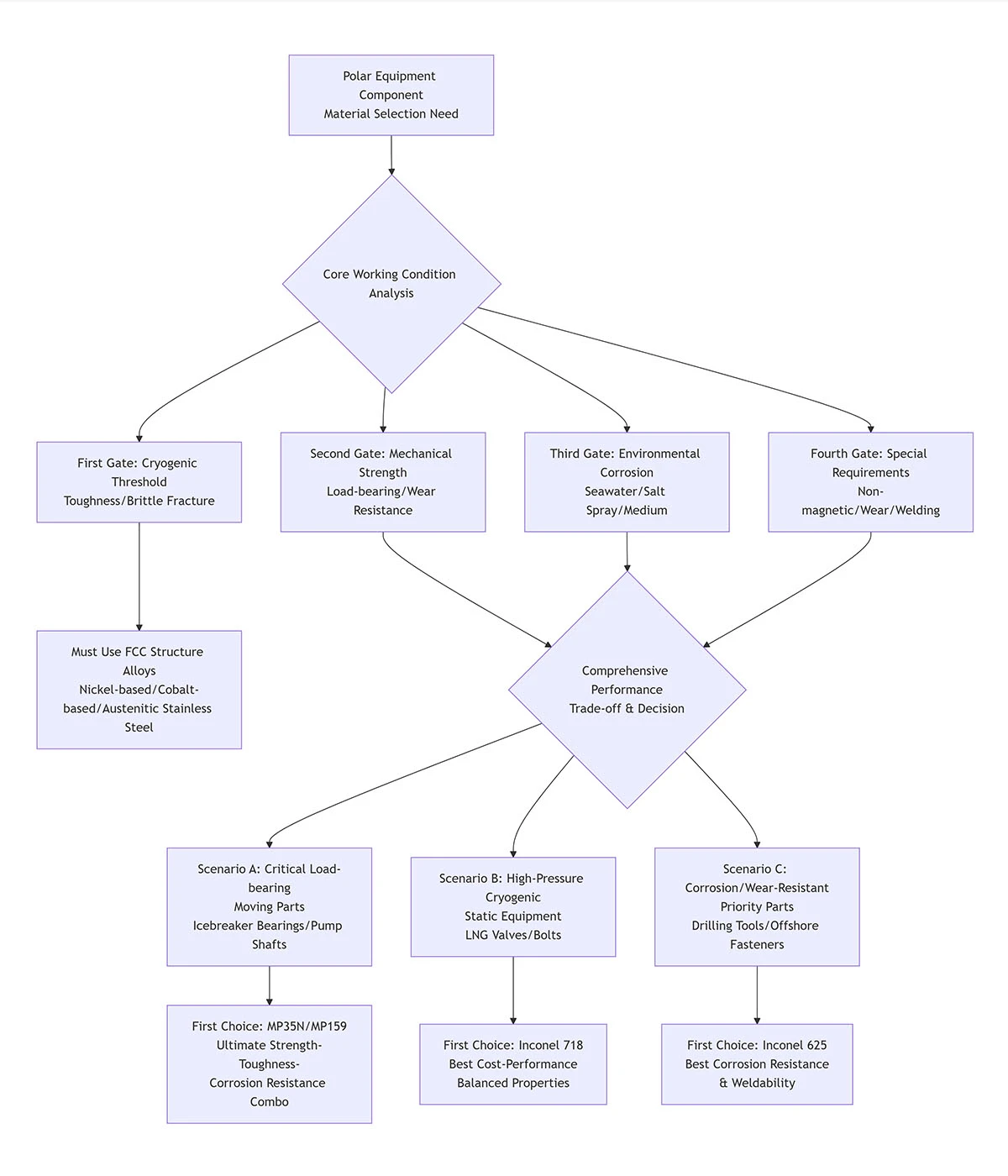
Core Application Scenarios and Material Selection Matrix
When we focus on the field of polar scientific research and resource development, the application logic of "high-temperature alloys" in this scenario differs from that in aerospace: it emphasizes long-term reliability, corrosion resistance, and maintenance-free operation under extreme temperatures, rather than ultimate high-temperature performance.
The following is a detailed analysis of typical applications, material selection logic, and technical challenges of high-temperature alloys and related special alloys in this field. (Click on the product image on the right for more information)
| Application Equipment |
Specific Components
|
Environmental Challenges
|
Preferred Materials and Rationale
|
Lork products
|
| Liquefied Natural Gas (LNG) Core Equipment | - Impellers, main shafts, and bushings of cryogenic pumps (submersible pumps, submerged pumps) - Fins and end caps of heat exchangers (plate-fin type) - Valve stems, valve cores, and fasteners of valves (globe valves, safety valves) |
Operating conditions: Ultra-low temperature (-162°C), direct contact with liquid hydrocarbons, high pressure, high rotational speed, requiring zero leakage and absolute safety. |
Inconel 718 / 625 |
|
| Polar Vessels and Icebreakers | - Propulsion Systems: Propeller shafts, bearings, sealing components - Critical fasteners and connectors for ice-strengthened structures - High-stress components of deck machinery, such as cranes and winches |
Low-temperature impact (-40°C to -50°C), seawater corrosion, ice loading (huge, irregular impact loads), and high wear. | MP35N / MP159 Reasons: 1. Unparalleled resistance to stress corrosion cracking, perfectly suited for seawater environments + high tensile stress. 2. Extremely high fatigue strength and impact resistance, capable of withstanding the huge alternating stresses generated by ice impacts. 3. Excellent wear resistance. The preferred choice for the most demanding applications. |
MP159 |
| Polar Drilling and Mining Equipment | - Drill pipe connectors, downhole tools - High-pressure piston rods and pump components for hydraulic systems - Exposed sensor housings, valve blocks |
Extreme cold + large temperature fluctuations, abrasive wear (ice, rock cuttings), corrosive drilling fluids, and special compatibility requirements for hydraulic oil at low temperatures. | Cobalt-based alloy (such as Stellite 6) hardfacing layer Inconel 718 Reasons: 1. Wear-resistant and corrosion-resistant combination: Cobalt-based alloy hardfacing provides surface wear resistance, while the nickel-based alloy substrate provides overall strength and toughness. 2. Can withstand complex chemical media. |
|
| Key Facilities of Permanent Scientific Research Stations | - Turbine components and fasteners for generator sets (diesel/gas turbine) - Precision sensor diaphragms and springs for environmental monitoring instruments - Expansion joints for outdoor piping systems |
Requirements: Long-term low-temperature cold start, temperature cycling, long-term maintenance-free operation, and extremely high material dimensional stability. | Inconel 718 / X-750 Reasons: 1. Excellent performance at both low and high temperatures, adapting to temperature changes from cold start to operation. 2. Excellent resistance to relaxation, maintaining preload force for springs and fasteners over the long term. 3. Minimal change in material properties over time. |
Inconel 718
|


 MP35N
MP35N



Special considerations and technical challenges for applications in polar environments.
1. Low-Temperature Toughness is the Entry Ticket, but Not the Whole Story
The ductile-brittle transition temperature must be far below the service temperature. This is the first hurdle in material selection.
Performance under dynamic loads: The impacts from equipment operation (such as icebreaking and drilling) are dynamic, requiring materials with high dynamic fracture toughness.
2. The Complexity of Corrosion
Polar marine atmospheric corrosion: Cold air containing sea salt particles is extremely corrosive.
Low-temperature condensate film corrosion: Even at low temperatures, a thin electrolytic film can form on the equipment surface.
The "passivation film" of high-temperature alloys remains stable at low temperatures, which is a significant advantage.
3. Tribological Challenges
Low-temperature lubrication failure: Ordinary lubricants solidify, leading to boundary lubrication or even dry friction.
The material itself must possess excellent wear resistance and anti-galling properties. This is why cobalt-based alloys (such as MP35N, Stellite) are widely used in bearings, sealing surfaces, and other friction pairs.
4. Extreme Difficulties in Manufacturing and Maintenance
No complex repairs or heat treatments can be performed on-site. This requires that the material possesses its final performance characteristics after manufacturing, and that performance degradation is extremely slow over its lifespan.
Welding and joining: All welding must be completed before delivery, using matching high-performance welding materials to ensure that the weld performance is consistent with the base material.
Four Essential Rules for Material Selection
- Data-Driven Approach, Avoid Extrapolating from Room Temperature Data
Obtain actual mechanical property data for materials at specific service temperatures (e.g., -50°C, -100°C), especially Charpy V-notch impact energy and fracture toughness.
Require suppliers to provide low-temperature impact test reports conforming to standards such as ASTM E23.
- Total Life Cycle Cost Calculation
In polar environments, the cost of a single failure can far exceed the material price difference. The material selection formula should be:
Total Cost = Material Procurement Cost + (Failure Rate × Repair Cost)
Although high-reliability materials have a higher unit price, they can significantly reduce the latter two items, thus lowering the total cost.
- Process Compatibility and Maintainability
Weldability: Polar equipment is often manufactured in modules and then transported; welding is critical. Inconel 625 has the best weldability, followed by 718, and MP35N is the most difficult.
Surface Treatment: Consider compatibility with specialized low-temperature lubricants and sealing materials for polar environments.
- Certification and Traceability
Materials must provide a complete traceability chain, from the melting furnace number to the final product.
Comply with specific material standards for the polar or offshore industry, such as NORSOK, DNV, and ABS.
Our Final Recommendations
As a procurement or technical intermediary, we have compiled the following points based on issues our previous clients have focused on. We wonder if you might be interested in them:
What are the worst-case consequences if this component fails? (Determining the safety level)
What kind of load does it primarily bear? Static or impact? (Determining the mechanical core)
What environmental media does it come into contact with? (Determining the type of corrosion)
What are the constraints on manufacturing and maintenance? (Determining the process route)
By answering these questions, you and your client can clearly pinpoint your position within the decision-making process above, thus making the most scientific, economical, and safe material choices. In extreme environments, materials are the cornerstone of safety; the selection must be prudent and professional. You can also contact us to discuss the ultimate solutions to these problems.
How To Cooperate With Us?
If you want to know more about the spot specifications of products or need customized products, get a quick quote, etc., please contact us!
Our address
Erqi District, Zhengzhou City, Henan Province, China
Phone Number
(86)-19937075488
susan@lorkgroup.com

Send Inquiry