


Why Do High-Power Magnetic Devices Require Fe-Co Alloys? An Analysis Of Vacoflux 50 Properties And Applications
Sep 18, 2026
Leave a message
High-power magnetic equipment relies on Fe-Co alloys because their saturation magnetic flux density exceeds 2.3 T-the highest among soft magnetic materials. This allows for a reduction of over 15% in core cross-sectional area for a given magnetic flux, directly enabling equipment lightweighting. Furthermore, their high Curie temperature of 950°C ensures that magnetic properties remain virtually undiminished at elevated temperatures, thereby guaranteeing the reliability of high-power equipment such as aviation and aerospace motors.
Core Conflict: The trade-off between high power density and equipment size.
Engineers designing high-end equipment-such as aerospace generators, drive motors for new energy vehicles, and high-precision servo systems-consistently face a core challenge: how to generate the strongest possible magnetic field within strict space and weight constraints. Conventional silicon steel sheets have a saturation magnetic flux density of approximately 2.0 T, while nickel-iron Permalloy ranges from only 0.8 to 1.6 T. In applications requiring high magnetic flux density, these limitations force an increase in core size and weight, severely restricting improvements in equipment power density.
Fe-Co alloys were developed specifically to address this challenge. Among iron-based soft magnetic materials, cobalt is the only element that, when alloyed with iron, simultaneously enhances both magnetic properties and the Curie temperature. When the cobalt content approaches 50%, Fe-Co alloys achieve the highest saturation magnetic flux density of any soft magnetic material, making them the "ultimate choice" for high-power-density electromagnetic equipment.
From Permendur to Vacoflux 50: The Engineering Value of Vanadium
The history of Fe-Co alloy development is essentially a chronicle of technological evolution aimed at resolving the conflict between "high magnetic performance" and "processability."
Although early 50Co-Fe alloys (Permendur) exhibited excellent magnetic properties, they suffered from critical engineering flaws: they were hard and brittle, incapable of cold working, and possessed extremely low electrical resistivity (approximately 7 μΩ·cm), resulting in massive high-frequency eddy current losses. In 1932, researchers developed "2V-Permendur" by adding about 2% vanadium to the 50Co-Fe composition, thereby significantly improving processability and increasing electrical resistivity. Vacoflux 50 represents the modern industrial embodiment of this technological trajectory.
The addition of vanadium plays three crucial roles:
- First, it inhibits the excessive growth of the brittle ordered phase (CoFe phase), enabling the alloy to be rolled into thin strips or stamped into complex core shapes;
- Second, vanadium atoms form a solid solution within the matrix, increasing electron scattering and raising electrical resistivity to approximately 40 μΩ·cm-roughly five to six times that of pure CoFe alloys-thereby reducing high-frequency eddy current losses;
- Third, vanadium enhances the alloy's ductility, allowing it to be manufactured into foils as thin as 0.1 mm or even less.
In-Depth Analysis of Vacoflux 50 Core Performance
1. Chemical composition
Vacoflux 50 is a high-performance soft magnetic iron-cobalt alloy with a typical chemical composition of approximately 49% Co, 49% Fe, and 2% V.
2. Magnetic and mechanical properties
| Property | Vacoflux 50 Typical Values |
| Saturation Magnetic Polarization Js | 2.30 T |
| Maximum Permeability μmax | 7,000 |
| Coercivity Hc | 100 A/m |
| Electrical Resistivity | 0.42 μΩ·m |
| Yield Strength Rp0.2 | 250 MPa |
| Tensile Strength Rm | 350 MPa |
| Young's Modulus | 215 GPa |
| Curie Temperature | 950°C |
The data above are typical values; actual performance may still be influenced by product condition, heat treatment, and testing conditions.
3. Key Features
Iron-cobalt (Fe-Co) alloys excel in high-power applications thanks to the following three core properties:
High Saturation Magnetic Flux Density
When iron and cobalt combine in an atomic ratio of approximately 1:1, the material exhibits the highest Slater-Pauling magnetic moment among known metallic soft magnetic materials, with a saturation magnetic flux density reaching up to 2.35 T. This represents a 20%–30% improvement over standard silicon steel, meaning that the cross-sectional area and volume of devices can be significantly reduced while transmitting the same magnetic flux.
Excellent Magnetic Permeability and Extremely Low Coercivity
Fe-Co alloys maintain exceptionally high magnetic permeability even at magnetic field strengths approaching saturation, ensuring electromagnets and electric motors retain superior response speeds and energy conversion efficiency under strong excitation currents.
Extremely High Curie Temperature
Fe-Co alloys typically have a Curie temperature exceeding 920°C. They maintain stable soft magnetic properties without magnetic degradation, even in the extreme high-temperature environments encountered by aerospace generators or automotive traction motors.
Typical industrial applications of Vacoflux 50
Thanks to its exceptional magnetic properties, Vacoflux 50 is widely used in cutting-edge manufacturing sectors that demand stringent performance regarding size, weight, and dynamic response:
Aerospace and Defense Electromagnetic Systems
Weight is a critical factor for aircraft onboard generators, aviation actuators, and UAV motors. Replacing conventional electrical steel with Vacoflux 50 can reduce the volume and weight of motors and transformers by 20% to 30% while enhancing reliability during continuous high-altitude operation.
Ultra-High-Speed EV/HEV Drive Motors
As new energy vehicles evolve toward ultra-high speeds exceeding 20,000 RPM and higher power densities, Vacoflux 50 is frequently used for stator and rotor laminations. It enables higher peak torque and significantly reduces the motor's overall envelope dimensions.

High-Frequency Precision Solenoid Valves and High-Speed Fuel Injectors
In diesel high-pressure common-rail systems and precision medical gas control valves, solenoid valves must open and close within millisecond or even microsecond timeframes. The combination of high saturation magnetic induction and low coercivity in Vacoflux 50 generates immense instantaneous electromagnetic attraction, drastically improving valve response speeds.
High-Field Electromagnets for Medical and Scientific Research
Vacoflux 50 serves as the pole-tip material in MRI focusing poles, particle accelerator steering magnets, and high-precision sensors, enabling the generation of strong, uniform, and localized magnetic fields.
Key Points for Purchasing and Use
Heat treatment is crucial for unlocking performance: the magnetic properties of Vacoflux 50 are highly sensitive to the heat treatment process. The recommended heat treatment involves holding the material at 820°C for 10 hours, followed by cooling at a rate of 100–200 K/h. Heat treatment in a hydrogen atmosphere or under vacuum is essential to achieve optimal soft magnetic properties.
Stress Sensitivity: Vacoflux 50 possesses a high magnetostriction coefficient (approximately 60–70 ppm), meaning that mechanical stress significantly affects its magnetic properties. Excessive clamping force or bending stress on the core must be avoided during assembly and operation; otherwise, magnetic permeability may decrease, and noise levels may rise.
Frequency Limitations: Due to its low electrical resistivity, Vacoflux 50 is suitable only for DC and low-frequency applications (typically below 400 Hz). Operation in medium- to high-frequency ranges requires the use of thinner laminations or alternative material systems.
Supply Forms
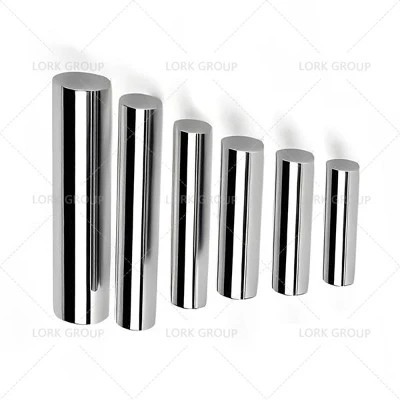
Vacoflux 50 is primarily supplied as solid bar stock and custom-shaped components, meeting international standards such as IEC 60404-8-6 F11 and ASTM A801, as well as the GB/T 14988 (1J22) standard.
Lork Group
Marketing Operations Department
Email: claire@lorkgroup.com
WhatsApp: +86 199 3707 5488
Send Inquiry