


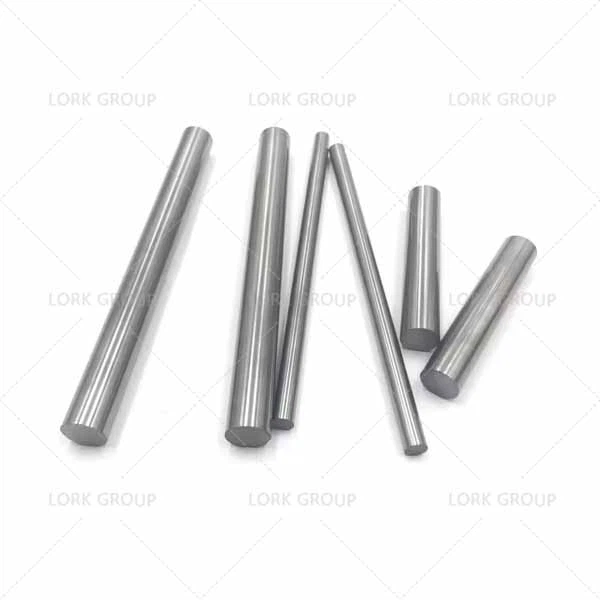


K390 Cold Work Tool Steel Bar
Product Introduction
K390 is an ultra-high-alloy cold-work tool steel produced using third-generation powder metallurgy technology. It stands as the "King of Wear Resistance" among powder metallurgy steels; however, it presents significant challenges in terms of machinability and heat treatment requirements. It is not intended for use in standard stamping workshops, but rather for applications involving the stamping of stainless steel or high-carbon steel-scenarios where the primary objective is to achieve a multi-fold increase in die lifespan.
The most valuable feature of this material lies in its 9% vanadium content. The vanadium forms vanadium carbide (VC), which boasts a hardness of HV 2600–2800-harder than the carbides of tungsten, molybdenum, or chromium. This 9% vanadium content translates to a high volume of hard VC particles embedded within the material; consequently, under abrasive wear conditions, the service life of materials such as M390, D2, and SKD11 amounts to merely a fraction of this material's lifespan.
Its typical applications include:
- Stainless Steel Stamping Dies: One of the most challenging materials to stamp, where the superior wear resistance of K390 is most evident.
- Cold Extrusion Dies: Requiring extremely high compressive strength to prevent die collapse.
- Deep Drawing Dies: High hardness ensures excellent surface finish and prevents galling.
- Precision Blanking Dies: For the mass production of silicon steel sheets, copper strips, and aluminum strips.
- Powder Compaction Dies: Used in the pharmaceutical industry and for ceramic pressing.
- Various Cutting Tools: Long-life cutting knives and industrial blades.
Comparative Analysis Against Mainstream Mold Steels
| Comparison Item | K390 | M390 | D2/SKD11 | SKH-51/M2 |
|---|---|---|---|---|
| Craftsmanship | Powder metallurgy | Powder metallurgy | Traditional smelting | Traditional smelting |
| Vanadium Content | 9% | 4% | 0.8% | 2% |
| Typical Hardness (HRC) | 62-65 | 60-62 | 58-62 | 62-65 |
| Abrasion resistance | Extremely High | High | Moderate | High |
| Toughness | Good | Good | Poor | Average |
| Compressive Strength | Extremely High | High | Moderate | High |
| Thermal Stability | Extremely High | High | Poor | Moderate |
| Primary Application | Average | High (High-Chrome) | Average | Poor |
| Primary Applications | Heavy-duty stamping, Cold extrusion | Plastic Molds, Cutting Tools | General Stamping | High-Speed Cutting |
The logic behind material selection is straightforward: for conditions involving pure abrasive wear, K390 represents the absolute pinnacle; if both corrosion resistance and wear resistance are required, choose M390; for cost-sensitive applications, D2 will suffice; and for manufacturing knives or drill bits, use M2.
Machining and Welding
This is the most "treacherous" aspect of K390. As a high-vanadium powder steel, its machining and heat treatment requirements are on an entirely different level compared to conventional tool steels.
1. Machining - Must be performed in the annealed state; cutting tools must be hard.
When working with K390, remember this: all complex shapes, holes, and slots must be completed while the material is in the annealed state. At this stage, the hardness is only around HRC 30, making it relatively easy to work with. After quenching, the hardness doubles to HRC 62; do not attempt to touch it with standard cutting tools-it can only be processed using a surface grinder.
2. Stress Relief (performed after rough machining).
3. Quenching - A precision operation requiring strict temperature control.
There are two available routes: a low-temperature route and a high-temperature route. Low-temperature quenching yields a hardness of HRC 62 with relatively superior toughness; high-temperature quenching yields HRC 65, maximizing wear resistance. The choice depends on the intended application: opt for the low-temperature route if edge chipping is a concern, or the high-temperature route if wear resistance is the priority.
4. Deep Cryogenic Treatment - To further eliminate retained austenite.
5. Tempering - Must be performed at least three times; low-temperature tempering is strictly prohibited.
6. Electrical Discharge Machining (EDM).
7. Grinding - Use CBN or diamond grinding wheels.
For more information, please contact:
Email: susan@lorkgroup.com
WhatsApp: +86 19937075488

Chemical Composition
(K390)
| element | Content Range |
| W | 1.00 |
| Mo | 3.80 |
| Cr | 4.20 |
| V | 9.00 |
| Mn | 0.40 |
| Si | 0.55 |
Mechanical and Physical Properties
| Performance Specifications | Numerical Value |
| Factory Condition | Soft annealed to ≤280 HB (approx. ≤29 HRC) |
| Hardness after quenching and tempering | Attainable hardness of 62–66 HRC; 62–64 HRC is commonly used |
| Abrasion Resistance | Extremely high |
| Toughness | Good |
| Heat Treatment Dimensional Stability | Extremely high |
| Density | ~7.9–8.0 g/cm³ (estimated) |
| Thermal conductivity | Approaching conventional cold-work tool steel |
Note on Hardness: In its annealed state, the hardness is merely ~280 HB, offering excellent machinability; however, following heat treatment, it "soars" to 62–64 HRC. This "stark contrast" in properties is a defining characteristic of K390: it is easy to work with when soft, yet offers exceptionally long wear resistance and service life once hardened.
Physical Properties
| Performance | Numerical Value |
| Melting Point Range | 1290–1350°C |
| Elastic Modulus | 207 GPa |
| Thermal Conductivity | 9.8–14.8 W/m·K |
| Electrical Resistivity | 1290 nΩ·cm |
| Magnetic Permeability | 1.0006 (Essentially non-magnetic) |
Technical Consultation Before Quotation
We have compiled a summary of key technical parameters regarding K390 cold work tool steel bar-points frequently discussed during past inquiries and procurement orders, to facilitate rapid quotation.
- Dimensions: Diameter/Side Length (typically φ1.5–300 mm); Length (for round bars, typically 300–1000 mm for short stock or 2000–4000 mm for long stock).
- Forms: Round Bar (Rolled/Forged), Flat Bar/Square Bar, Block/Module, Plate.
- Condition: Annealed (Soft) or Pre-hardened/Heat-treated?
- Surface Finish: Black (As-forged/As-rolled), Turned, Ground.
- Certification Requirements: Must an original, traceable Mill Test Certificate be included? Is a third-party inspection required?
Recommendations for Selecting Condition:
If you intend to perform your own Wire EDM or CNC machining to create complex shapes → Annealed Condition (≤30 HRC); this option is more economical and easier to machine.
If you intend to use the material in its finished shape without further processing, → Pre-hardened/Heat-treated Condition (i.e., Quenched and Tempered; ready for direct mold assembly).
Hot Tags: k390 cold work tool steel bar, China k390 cold work tool steel bar manufacturers, factory
You Might Also Like


Send Inquiry