

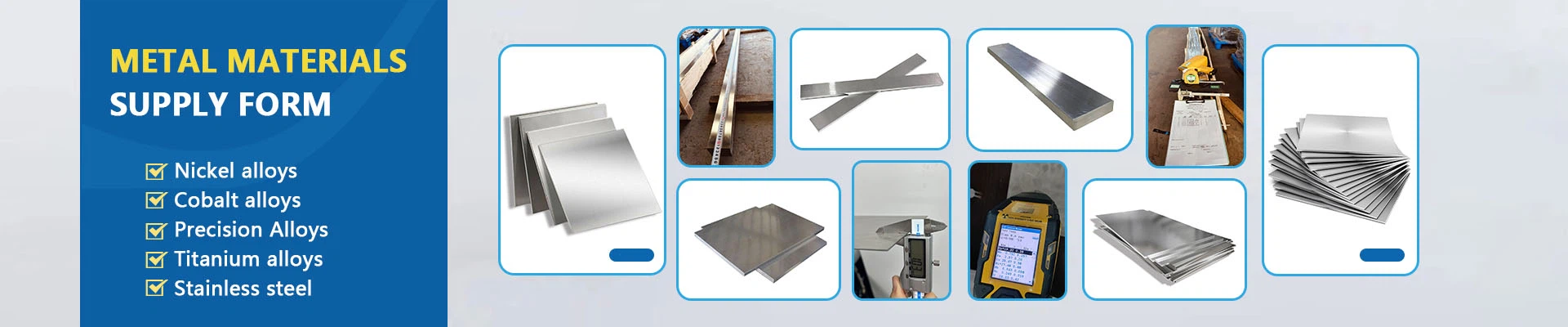


Inconel 686 Nickel Alloy Plate
Product Introduction
Inconel 686 exhibits superior performance in oxidising, reducing, and mixed acid media (especially those containing halides such as chlorides and fluorides); it also boasts top-tier resistance to pitting corrosion, crevice corrosion, stress corrosion cracking, and intergranular corrosion.
The main specifications of the Inconel 686 we offer are: thickness, hot-rolled plate <30mm, and medium-thick plate ≥3.0mm, conforming to standards such as ASTM B168. Please get in touch with us for a technical specification sheet or a quote.
Practical Guide to Market Procurement
When inquiring about prices and placing orders, it is crucial to clearly define the following information:
- Product Form and Specifications:
Common thicknesses of Inconel 686 alloy plates include hot-rolled plates (thickness <30mm) and medium-thick plates (thickness ≥3.0mm). Specific widths and lengths can usually be customised based on requirements, including the specific application environment and purchase quantity.
- Key Standards:
ASTM B168/ASME SB168: This is the core material standard for thick plates, thin plates, and strips of nickel-chromium-iron-molybdenum alloy (UNS N06686), specifying in detail the requirements for composition, mechanical properties, etc.
GB/T 38688-2020: The Chinese national standard applicable to hot-rolled thick corrosion-resistant alloy plates with thicknesses from 3.0mm to 200mm.
- Delivery Condition:
Plates are typically supplied in solution-annealed and pickled conditions to ensure optimal corrosion resistance and ductility.
- Supplier Qualifications:
When selecting suppliers, priority should be given to manufacturers orauthorisedd distributors of speciality alloy plates with a complete quality system. For applications with stringent requirements (such as aerospace), it is particularly important whether the supplier has relevant certifications such as AS9100 (for specific ISO, CE, AS, and AAA certifications, please refer to Lork Alloy - About Us or contact us to view the original documents).
Manufacturing Process and Challenges
Inconel 686 alloy sheet exhibits a significant work-hardening tendency, classifying it as a difficult-to-machine material.Special care must be taken: Whether purchasing raw materials, machining simple parts, or precision-machined parts, the following points should be noted by skilled machining personnel regarding secondary processing:
Cold Working:
During cold working processes such as stamping and bending, the material hardens rapidly. Strict control of the deformation per pass is essential. For moderate cold forming, intermediate annealing may be necessary to restore the material's plasticity and prevent cracking.
Machining:
Its high strength, low thermal conductivity, and work hardening properties are unfavorable for machining, leading to rapid tool wear.
Using rigid equipment and wear-resistant carbide tools is recommended. During machining, cryogenic cooling or cryogenic cooling helps control cutting temperature and improves machining results.
For more information, please contact:
Email: susan@lorkgroup.com
WhatsApp: +86 19937075488

Chemical Composition
| Weight% | Alloy 686 |
| Ni | Bal |
| Cr | 19-23% |
| Mo | 15-17% |
| W | 3-4.4% |
| Fe | ≤5.0% |
Mechanical Properties
| Material | (Typical values of solution-treated sheet material) |
| Tensile Strength MPa | ≥690 MPa (or ~721 MPa) |
| Yield Strength MPa | ≥310 MPa (or ~364 MPa) |
| Reduction of Area % | ≥40% (or ~71%) |
| Elastic Modulus | Approximately 207 GPa |
Key Points of Quality Inspection Process
During procurement, the following testing items and requirements should be clearly written into the technical agreement:
1. Chemical Composition Analysis: Upon arrival, spectral analysis should be performed to verify that the composition (especially key elements such as Cr, Mo, and W) meets the standard requirements.
2. Mechanical Property Testing: Room temperature tensile tests should be conducted to verify that tensile strength, yield strength, and elongation meet the standards.
3. Non-destructive Testing: For medium-thick plates, ultrasonic testing (UT) is crucial. A 100% area scan should be performed according to standards (such as ASTM A578 Level B or higher) to ensure no internal defects exceeding the standards (such as delamination or inclusions).
4. Metallographic Analysis: Inspect grain size (typically ≥ ASTM Grade 5) and assess for harmful phase precipitation.
5. Corrosion Resistance Testing: For applications with stringent corrosion resistance requirements, intergranular corrosion testing (e.g., ASTM G28 Method A) or pitting/crevice corrosion testing (e.g., ASTM G48) may be required.
6. Document Review: Obtain complete material certificates (MTC/MTR). Documents should include complete chemical composition, mechanical properties, heat treatment records (solution treatment), and non-destructive testing reports (if applicable). Confirm that each batch of material has a traceable furnace number/lot number.
Hot Tags: Inconel 686 Nickel Alloy Plate, China Inconel 686 Nickel Alloy Plate manufacturers, factory
You Might Also Like


Send Inquiry