

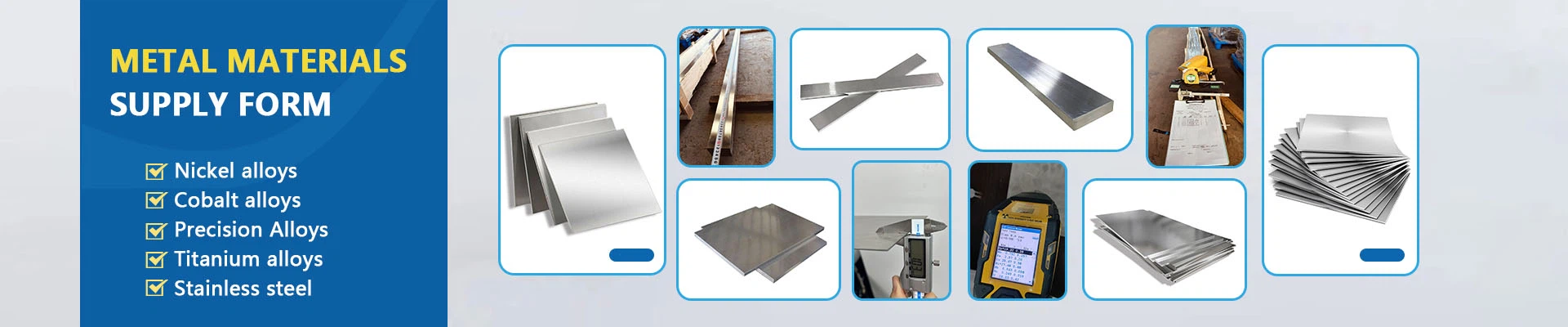


Haynes 617 Nickel Alloy Plate
Product Introduction
Haynes 617 is a solution-strengthened nickel-chromium-cobalt-molybdenum alloy designed for extreme high-temperature oxidizing environments. It possesses core properties such as exceptionally high-temperature strength and oxidation resistance, excellent creep resistance, and good thermal stability and weldability.
The mainstream industry standards (examples) for Haynes 617 nickel alloy plates are ASTM B168 (General), AMS 5885 (Aerospace, Most Strictest), and ASME SB-168 (Pressure Vessel). Welding material: AWS A5.14 ERNiCrCoMo-1. Please get in touch with us for a technical specification sheet or a quote.
Practical Guide to Market Procurement
1. Supplier Screening (High Threshold):
Qualifications are the Bottom Line: For high-end applications such as aerospace and energy, suppliers must be able to reliably supply materials conforming to AMS 5885 standards. Manufacturers with NADCAP certification (especially for heat treatment and NDT processes) are preferred, while suppliers with AS9120, ISO, CE, etc. certifications are secondary choices (for these certificates, please contact us to view the originals, or visit the Lork Alloy website - About Us).
2. Assess Process Capabilities:
Inquire about their plate production process. Can they provide plate blanks produced using Vacuum Induction Melting (VIM) + Electroslag Remelting (ESR) or Vacuum Arsenic Remelting (VAR)? What is the temperature control accuracy and cooling capacity of their heat treatment furnaces? These are fundamental to quality.
Examine Application Performance: Request supply case studies in gas turbines, nuclear power, and other fields, preferably with user reports.
3. Cost and Negotiation Points:
Complex Price Structure: Prices are linked to futures prices for metals such as nickel and cobalt, and processing fees account for a very high percentage. It's crucial to understand whether it's a "base price + alloy surcharge" model or a package price.
Pay attention to minimum order quantity and delivery time: The production cycle for these special sheets is extremely long (typically 3-6 months, longer for special specifications), with limited inventory. Plan ahead meticulously, and ensure the contract clearly specifies delivery dates and penalties for breach of contract.
4. Prioritize technical agreements:
Before negotiating prices, secure a technical agreement, finalizing all material standards, conditions, testing requirements, acceptance criteria, and document delivery lists. The technical agreement is an integral part of the commercial contract.
Manufacturing Process and Challenges
When purchasing this Haynes 617 nickel alloy plate, you must be aware that its processing cost may far exceed the material itself. Whether purchasing raw materials, machining simple parts, or precision-machined parts, the following points should be noted by skilled machining personnel regarding secondary processing:
Hot Working: Hot forging and hot rolling are possible, but the temperature window must be strictly controlled (typically within the range of 1175-1230°C), and rapid cooling (water cooling) is required afterward to achieve a solution-annealed state, which is challenging for large plates.
Cold Working: Cold rolling or bending is possible, but work hardening is significant, potentially requiring intermediate annealing. One study mentioned that after 10%-20% cold deformation of 617 alloy, heat treatment at 1040-1120°C alters its properties, indicating that processing history significantly impacts final performance.
Machining (Cutting): This is a recognized challenge. It has high strength, poor thermal conductivity, and is prone to tool sticking and severe work hardening during cutting. High-performance carbide or ceramic tools must be used, employing low speeds, high feed rates, and adequate cooling. Tool costs are high, and machining efficiency is low; sufficient time and budget must be allocated during quotation and production scheduling.
For more information, please contact:
Email: susan@lorkgroup.com
WhatsApp: +86 19937075488

Chemical Composition
| Weight% | Haynes 617 |
| Ni | Bal |
| Cr | 20.0-24.0% |
| Mo | 8.0-10.0% |
| Ai | 0.8-1.5% |
| Co | 10.0-15.0% |
Mechanical Properties
| Material | (Solution-annealed state) |
| Tensile Strength MPa | ≥655 |
| Yield Strength MPa | ≥240 |
| Reduction of Area % | ≥35% |
| Hardness HB | 180-220 |
Key Points of Quality Inspection Process
With Haynes 617 nickel alloy plate metal, you're not buying a "product," but a "high-performance engineering solution." Its value lies in ensuring equipment can operate safely for tens of thousands of hours at extreme temperatures without failure. The testing of this material must be contractual and documented.
1. Document Review (Crucial):
Material Certificate (MTR/CMTR): This is the material's "identity card." It must include: furnace number (key for traceability), measured chemical composition and spectral analysis (verifying compliance with standards), measured mechanical properties report (at least including room temperature tensile testing), heat treatment record (proving solution treatment and rapid cooling), and non-destructive testing (NDT) report.
Conformity Certificate: A declaration of compliance with specified standards such as AMS 5885 or ASTM B168.
Hot Tags: haynes 617 nickel alloy plate, China haynes 617 nickel alloy plate manufacturers, factory
You Might Also Like


Send Inquiry