

Inconel 625LCF: A Specialized Nickel-based Alloy Designed For Fatigue Resistance in Bellows.
Aug 12, 2026
Leave a message
Bellows operating status
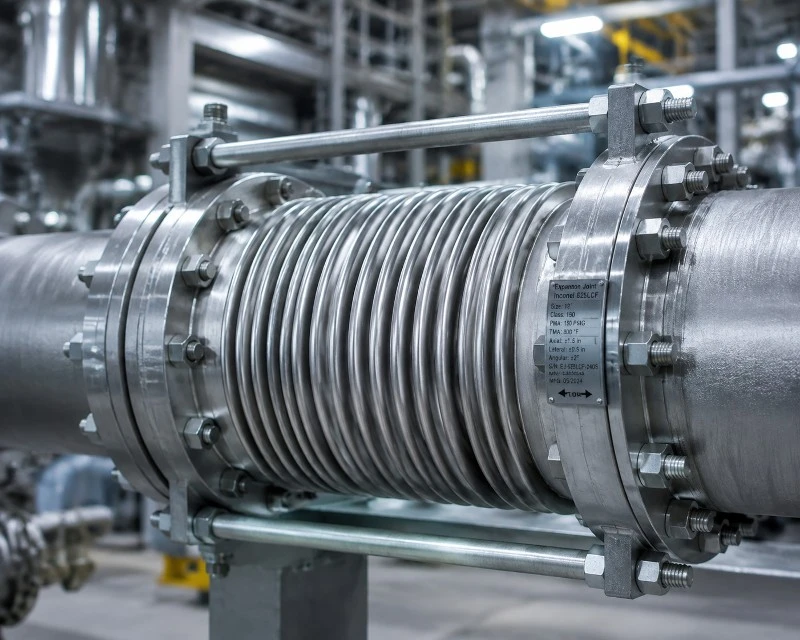
As critical flexible compensation components in piping systems, bellows operate under harsh, combined conditions involving alternating stresses, temperature fluctuations, and corrosive media. Frequent expansion, contraction, and bending impose typical low-cycle fatigue loads, while thermal fatigue from cycling and oxidation or corrosion from the operating environment further accelerate material degradation.
Conventional stainless steel bellows often fail prematurely in such environments due to the initiation and propagation of fatigue cracks-leading to sealing leaks and unplanned shutdowns-which drove the development of Inconel 625LCF.
The ideal choice for harsh operating conditions.
Inconel 625LCF is a nickel-based alloy optimized for fatigue resistance, developed from the standard Inconel 625 grade. While retaining excellent corrosion resistance, it extends low-cycle fatigue life to a level up to a hundred times that of standard Inconel 625.
Given the operational demands placed on bellows, the combination of fatigue resistance, corrosion resistance, and thermal stability offered by Inconel 625LCF makes it an ideal material solution for ensuring the long-term, reliable operation of critical components.
Technical Data
1. Chemical composition
| Element | Content (%) |
|
Ni |
min 58.00 |
|
Cr |
20.00-23.00 |
|
Mo |
8.00 - 10.00 |
|
Nb+Ta |
3.15 - 4.15 |
|
Fe |
max5.00 |
|
C |
max0.03 |
|
Si |
max0.02 |
|
N |
max0.02 |
Compared to standard Inconel 625, the most notable aspect of the chemical composition of Inconel 625LCF is the stricter limitation placed on elements such as carbon (C), silicon (Si), and nitrogen (N).
2. Mechanical properties (room temperature)
| Performance indicators | Inconel 625LCF |
| Yield strength | min. 380MPa |
| Tensile strength | min. 760MPa |
| Elongation | min. 35% |
3.Physical properties
| Performance indicators | Inconel 625LCF |
| Density | 8.44 g/cm³ |
| Melting range | 1290–1350°C |
| Modulus of elasticity (room temperature) | 208 GPa |
Disclaimer: The data in this article are typical values or reference ranges and are for reference only. Actual performance is subject to the material quality certificate and measured data.
How to achieve "fatigue resistance" performance
Inconel 625LCF achieves superior low-cycle fatigue strength through the optimization of alloy composition, melting processes, and material processing techniques.
During manufacturing, processes such as vacuum induction melting are employed to keep the levels of impurities-such as carbon (C), silicon (Si), and nitrogen (N)-extremely low (e.g., C ≤ 0.03%, Si ≤ 0.15%), thereby reducing the risk of fatigue crack initiation. Simultaneously, precision thermomechanical processing techniques are used to produce a uniform, refined grain structure-with an average grain size of ASTM Grade 5 or finer-effectively inhibiting the initiation and propagation of fatigue cracks.
As a result of these combined measures, Inconel 625LCF demonstrates exceptional service life in low-cycle fatigue environments, achieving a fatigue life up to 100 times that of conventional Inconel 625.
Why choose Inconel 625LCF for high-end corrugated pipes?
For the manufacture of high-performance bellows, material selection directly determines product service life and safety ratings. The advantages of Inconel 625LCF are primarily reflected in the following areas:
Resistance to low-cycle and thermal fatigue
Specifically designed for cyclic loading with high strain amplitudes, it maintains excellent fatigue resistance even under thermal cycling conditions involving frequent start-stop operations and drastic temperature fluctuations.
01
Inherited corrosion resistance
It retains the outstanding corrosion resistance of Inconel 625 in both oxidizing and non-oxidizing media, enabling it to withstand corrosive challenges posed by flue gases, process media, and high-temperature steam.
02
Good formability and weldability
Bellows walls can be as thin as 0.1 mm, requiring multiple stages of cold forming and welding; 625LCF offers excellent processing adaptability to meet precision manufacturing requirements.
03
Service temperature limits
The recommended upper limit for long-term service is approximately 650°C. This is because the fine-grained microstructure-while enhancing fatigue resistance-also reduces high-temperature creep strength; consequently, long-term use under high-stress conditions exceeding this temperature is not recommended.
04
application
The core application scenarios for 625LCF all center on its key advantage: fatigue resistance.
Aerospace: Bellows for aero-engine exhaust systems, engine ducts, heat shields, and various high-temperature fasteners, all required to withstand severe thermal cycling and mechanical vibration.
Automotive Industry: Flexible connecting bellows for high-performance turbocharger exhaust systems, addressing thermal expansion compensation and vibration damping for hot-end components.
Industry and Energy: Expansion joints and corrugated compensators for process piping in the chemical industry, designed to offer both corrosion resistance and resistance to cyclic loading.
Selection Recommendations
You need to determine whether your application scenario is suitable for the 625LCF.
| Recommended for use |
●Components frequently subjected to alternating stresses (low-cycle fatigue loads) ●Service temperature below 650°C ●Requirement for corrosion resistance ●Bellows and expansion joint components |
| Not recommended |
●Service temperatures exceeding 650°C and high stress levels ●Primary failure mode is creep rather than fatigue ●Requires only corrosion resistance; no fatigue requirements (standard Grade 625 suffices) |
Media Contact
Lork Group | Brand & Marketing Department
Email: claire@lorkgroup.com
Phone: +86 199 3707 5488
Send Inquiry